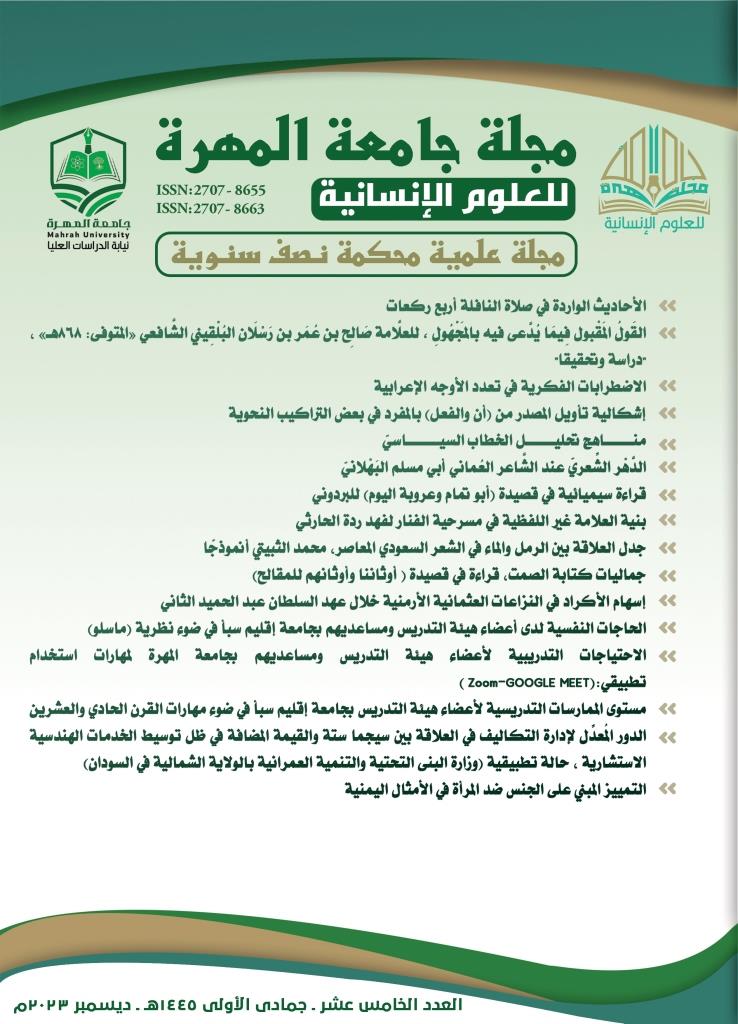
الدور المُعدِّل لإدارة التكاليف في العلاقة بين سيجما ستة والقيمة المضافة في ظل توسيط الخدمات الهندسية الاستشارية
حالة تطبيقية (وزارة البنى التحتية والتنمية العمرانية بالولاية الشمالية في السودان)
DOI:
https://doi.org/10.71311/.v4i2.126Keywords:
إدارة التكاليف, سيجما ستة, الخدمات الهندسية الاستشارية, القيمة المضافة, وزارة البنى التحتية والتنمية العمرانية بالولاية الشماليةAbstract
هدفت الدراسة لبيان الدور المُعدِّل لإدارة التكاليف في العلاقة بين سيجما ستة والقيمة المضافة في ظل توسيط الخدمات الهندسية الاستشارية بوزارة البنى التحتية والتنمية العمرانية بالولاية الشمالية، واستخدمت المنهج الوصفي التحليلي والمنهج التاريخي، وتمثلت عينة الدراسة في المهندسين بعدد (50) مفردة، وتوصلت الدراسة إلى تُعدِّل إدارة التكاليف العلاقة بين سيجما ستة والقيمة المضافة بقيمة تغير في معامل التحديد (0.212)، وتتوسط الخدمات الهندسية الاستشارية العلاقة بين سيجما ستة والقيمة المضافة بتأثير غير مباشر (0.34)، وأوصت الدراسة بضرورة توعية القيادة والمهندسين بأهمية إدارة التكاليف وسيجما ستة والخدمات الهندسية الاستشارية والقيمة المضافة بالوزارة.
The study aimed to investigate the moderator role of cost management in the relationship between six sigma and additive value under the mediation of consulting engineering services at Ministry of Infrastructure and Urban Development in the Northern State of Sudan. The study adopted the descriptive analytical method and the historical method. The study sample consisted of (50) engineers. As The study resulted the cost management moderator in the relationship between six sigma and additive value with a change in the determination coefficient of (0.212).The consulting engineering mediates the relationship between six sigma and additive value with an indirect effect of (0.34). The study recommended that, there is a need to increase the awareness of leadership and engineers at the ministry about the importance of cost management, six sigma, consulting engineering services and additive value.
Downloads
Downloads
Published
How to Cite
Issue
Section
License
Copyright and Licensing
copyright is retained by the authors. Articles are licensed under an open access Creative Commons CC BY 4.0 license, meaning that anyone may download and read the paper for free. In addition, the article may be reused and quoted provided that the original published version is cited. These conditions allow for maximum use and exposure of the work.